
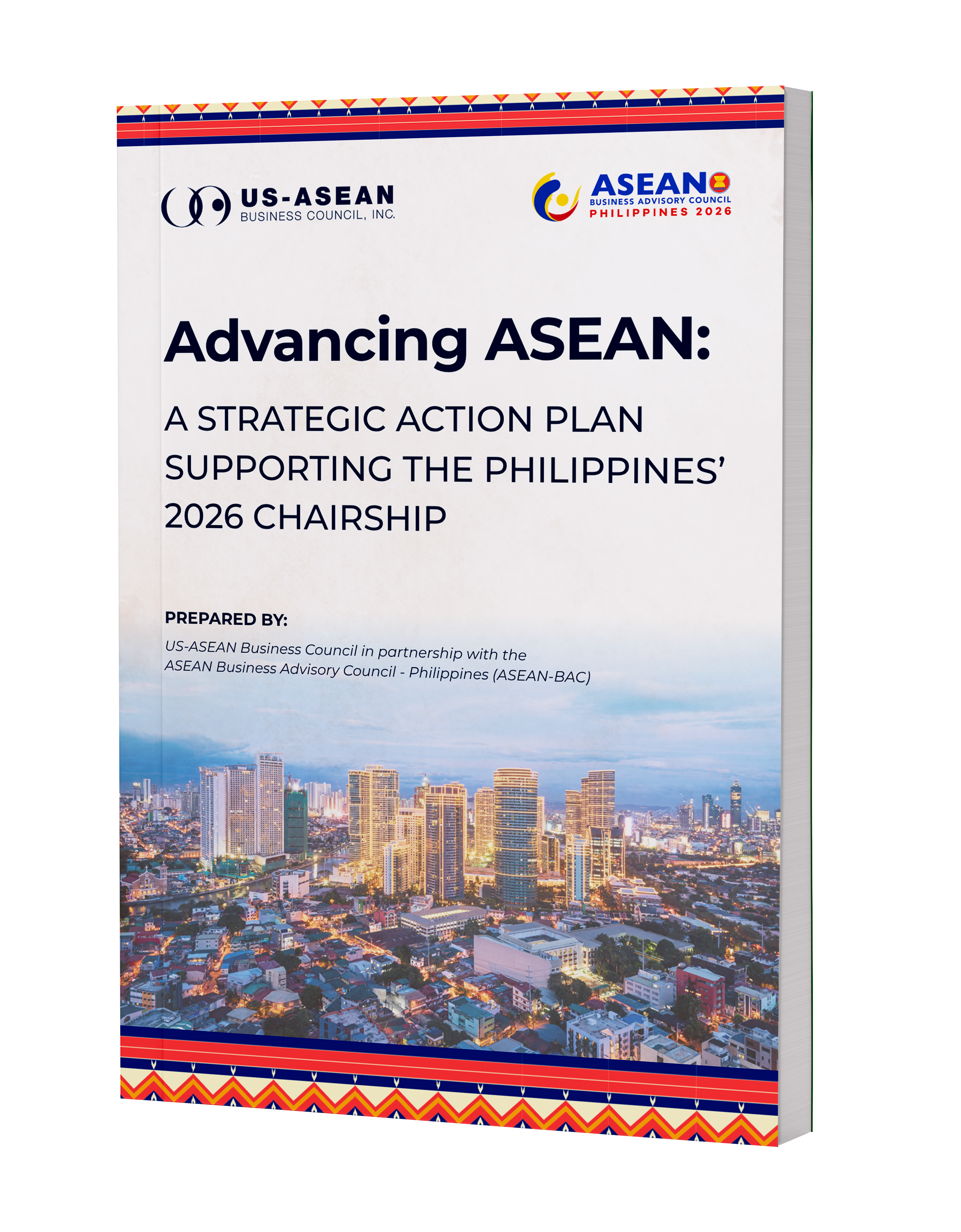
The Strategic Action Plan
Created in partnership with the ASEAN Business Advisory Council (ASEAN BAC) Philippines, the Strategic Action Plan (SAP) is a forward-looking policy framework designed to support the Philippines’ 2026 ASEAN Chairship and ASEAN’s broader regional priorities. Through close collaboration between the public and private sectors, this initiative contributes practical solutions across five strategic pillars: sustainability and food security; healthcare; sustainable supply chains and logistics; digital economy and and workforce development; and artificial Intelligence. The SAP is grounded in five Discussion Papers, each taken up in a dedicated Roundtable Discussion held from March to April 2026 with government agencies, development partners, and civil society. It serves not only as a Chairship-year agenda, but as a long-term roadmap intended to establish institutional foundations that future ASEAN Chairships—Singapore in 2027 and Thailand in 2028—can build upon.
On April 29, Ambassador Brian McFeeters (ret.) led the official launch of the Strategic Action Plan (SAP), presenting it to the Philippine Government in its capacity as the 2026 ASEAN Chair. Developed in partnership with ASEAN-BAC Philippines and shaped by exchanges with key Philippine Government agencies, the SAP consolidates USABC’s private sector proposals across five strategic pillars: food security, healthcare, supply chains and logistics, digital economy and workforce development, and artificial intelligence. It is grounded in five Discussion Papers, each taken up in dedicated roundtable discussions held from March to April 2026 with public and private sector stakeholders.
Coinciding with the 80th anniversary of Philippines-U.S. diplomatic relations, the SAP reflects the U.S. private sector commitment to supporting the Philippines in its regional leadership at a moment of urgency for ASEAN’s economic and energy priorities. Philippine President Ferdinand R. Marcos Jr. and ASEAN Secretary-General Kao Kim Hourn both, in video messages, welcomed the proposed plan, a strong signal of support ahead of the 48th ASEAN Leaders’ Summit in May.
As the Chairship year progresses, USABC is actively working to convene an ASEAN-U.S. Strategic Dialogue timed around the ASEAN Summit in November. The Dialogue is envisioned as an opportunity to evaluate progress on the Strategic Action Plan and to chart the course forward together toward Singapore’s 2027 Chairship and beyond.
Discussion Paper #1: Sustainability and Food Security
This paper responds to the growing recognition that health outcomes, food systems, and environmental sustainability are deeply interconnected, yet often addressed through fragmented policies and institutions. Rising noncommunicable diseases, climate-related supply disruptions, antimicrobial resistance, and persistent food loss and waste continue to challenge the region. The initiative seeks to translate existing ASEAN strategies into coordinated, scalable actions through stronger regulatory coherence and public–private cooperation. It also aligns with ASEAN Economic Community priorities and key Philippine Priority Economic Deliverables.
The initiative advances four mutually reinforcing projects: (1) ASEAN Health and Agriculture Nexus Initiative, a platform for cross-sector dialogue on health, agriculture, and sustainability; (2) ASEAN Circular Economy Platform, which promotes coherent extended producer responsibility systems and recycling investment; (3) ASEAN Sustainable Supply Chain Resilience Initiative, focused on digital traceability, climate resilience, and interoperable standards across food and healthcare supply chains; and (4) ASEAN Nutrition Security and Health Promotion Collaborative, which supports healthier food environments through nutrient profiling, mutual recognition pathways, and practical policy toolkits. Together, these projects position the Philippine Chairship as a catalyst for resilient, sustainable, and health-promoting regional food systems.
Discussion Paper #2: Healthcare
This paper recognizes healthcare as both a social and economic priority as ASEAN faces rapid population aging, rising noncommunicable diseases, mental health pressures, and increasing healthcare costs. These challenges are compounded by workforce shortages, uneven rural access, and fragmented health information systems that limit coordinated care and evidence-based policymaking. At the same time, ASEAN has strong institutional foundations through its health sector bodies, ACPHEED, and lessons learned from past pandemics. The initiative builds on this momentum to strengthen prevention, resilience, and digital transformation.
The paper proposes four flagship initiatives: (1) ASEAN Preventive Health Systems Accelerator, promoting nutrition labeling, health education, mobile health tools, and hospital malnutrition standards; (2) ASEAN Health Supply Chain Resilience and Cold Chain Security Program, focused on logistics mapping, workforce training, and sustainable cold chain systems; (3) ASEAN High-Level Forum on Artificial Intelligence for Health and Preventive Healthcare, which develops regional policy recommendations for responsible AI in healthcare; and (4) ASEAN Digital Health Interoperability and Regulatory Harmonization Laboratory, a technical platform supporting digital health standards, regulatory convergence, and cybersecurity readiness. Collectively, these initiatives aim to deliver visible outcomes during the Chairship year while reinforcing ASEAN’s long-term health system resilience.
Discussion Paper #3: Sustainable Supply Chains and Logistics
This paper is designed to strengthen ASEAN competitiveness through efficient, transparent, and resilient trade systems. Persistent customs inefficiencies, regulatory divergence, illicit trade, and limited access to renewable energy continue to raise costs and weaken supply chain performance across the region. Although ASEAN has made progress through trade facilitation frameworks and sustainability commitments, coordination gaps across customs, regulatory, and enforcement agencies remain significant. The Philippines’ 2026 ASEAN Chairship presents an opportunity to advance practical reforms that support trade, investment, and sustainability. The initiative also builds on Malaysia’s 2025 Chairship and aligns with ASEAN’s long-term economic integration agenda.
The paper advances four projects: (1) ASEAN High-Level Dialogue on Sustainable and Secure Supply Chains, a platform for coordination on customs modernization, regulatory convergence, and sustainable logistics; (2) ASEAN Technical Program on Digital Customs and Paperless Trade, supporting ASEAN Single Window interoperability and risk-based border systems; (3) ASEAN Regulatory Harmonization Dialogue for Market Access and Circular Economy Integration, which addresses compliance barriers and promotes mutual recognition frameworks; and (4) ASEAN Joint Program on Strategic Trade Management and Illicit Trade Prevention, strengthening enforcement capacity and digital tracking systems. Together, these initiatives position sustainability as a driver of competitiveness and support deeper regional integration.
Discussion Paper #4: Digital Economy and Workforce Development
This paper addresses persistent regional challenges in infrastructure gaps, digital skills shortages, MSME digital adoption, cybersecurity threats, and fragmented regulatory systems. While ASEAN has adopted frameworks such as the Digital Economy Framework Agreement (DEFA), progress often occurs in parallel rather than through coordinated implementation. MSMEs, which account for the overwhelming majority of ASEAN businesses, continue to face barriers in adopting digital tools and participating in e-commerce. The Philippines’ 2026 Chairship offers an opportunity to accelerate digital integration, workforce readiness, and trusted digital ecosystems. The initiative emphasizes continuity with Malaysia’s 2025 priorities and ASEAN’s broader economic agenda.
The paper proposes four mutually reinforcing projects: (1) ASEAN Digital Interoperability and Payments Connectivity Forum, focused on cross-border payments and technical standards; (2) ASEAN MSME Digital Transformation and Inclusive Growth Program, offering training, toolkits, and digitalization roadmaps for small businesses; (3) ASEAN Regional Academy for Digital Workforce Development, providing AI literacy, cybersecurity, and data governance certification programs; and (4) ASEAN Digital Trust, Cyber Resilience, and Online Safety Initiative, aimed at combating fraud, scams, and enforcement gaps through regional coordination. These initiatives seek to turn ASEAN’s digital commitments into practical outcomes that expand opportunity across Member States.
Discussion Paper #5: Artificial Intelligence
This paper positions AI as both an economic driver and an enabling technology for resilience, inclusion, and competitiveness across ASEAN. While the region’s digital economy continues to expand rapidly, fragmented governance approaches, cybersecurity risks, infrastructure gaps, constrained cross-border data flows, and talent shortages threaten to slow AI adoption. The initiative therefore supports a risk-based, interoperable approach to AI governance aligned with ASEAN frameworks and long-term regional integration goals. It also reflects Philippine and ASEAN priorities on ethical AI, digital inclusion, and innovation-led growth. The proposals are structured as implementation-ready programs that Member States can endorse and scale.
The paper outlines five flagship initiatives: (1) U.S.–ASEAN AI Summit, a multi-track forum producing policy recommendations and pilot projects; (2) Digital Transformation in Government Workshop Series (DIGIT) on AI, building AI readiness among ASEAN public officials; (3) ASEAN Secure AI and Critical Infrastructure Resilience Initiative, developing frameworks and simulations for secure AI deployment; (4) ASEAN Center for the Workforce of the Future, a regional hub for AI skills development, inclusion, and talent mobility; and (5) ASEAN Digital Data Corridor Pilot, demonstrating trusted cross-border data flows for AI-enabled trade, disaster response, and disease surveillance. Together, these initiatives aim to strengthen ASEAN’s digital competitiveness, security, and inclusive growth trajectory.
