
Johor's Election Result Offers Continuity for the State and Raises Stakes for GE16





Johor held its 16th state election on July 11, with the contest widely viewed as an important political test for Malaysia’s 16th General Elections (GE16). The election took place against a unique backdrop in which Barisan Nasional (BN) and Pakatan Harapan (PH) are partners at the federal level under the Unity Government, while remaining electoral competitors in Johor state politics.
As one of Malaysia's largest and most economically significant states, Johor has traditionally been viewed as an important indicator of national political trends. While Johor's result does not necessarily predict the outcome of GE16, it provides BN with important political momentum. Attention will now turn to the upcoming Negeri Sembilan state election on August 1, followed by Melaka later this year, where the performance of the major coalitions will provide further insight into voter sentiment and the evolving political landscape ahead of GE16.
BN Expands Majority as PH Decline
The result delivered a decisive victory for BN, winning 48 of the 56 seats, improving on its already dominant performance in the 2022 Johor election when it secured 40 seats. PH saw its representation decline from 12 to 8 seats, while other parties, including opposition Perikatan Nasional (PN), and independent candidates failed to win any seats. Analysts attribute BN's landslide victory to strong public support for incumbent Menteri Besar Onn Hafiz Ghazi's government, which benefited from Johor's robust economic growth. This includes its position as the highest concentration of investment in data center development in ASEAN, as well as voter preference for political stability amid major infrastructure investment initiatives such as the Johor-Singapore Special Economic Zone (JS-SEZ). The opposition was further weakened by poor coordination, fragmented vote-splitting in multi-cornered contests, and an inability to consolidate support.
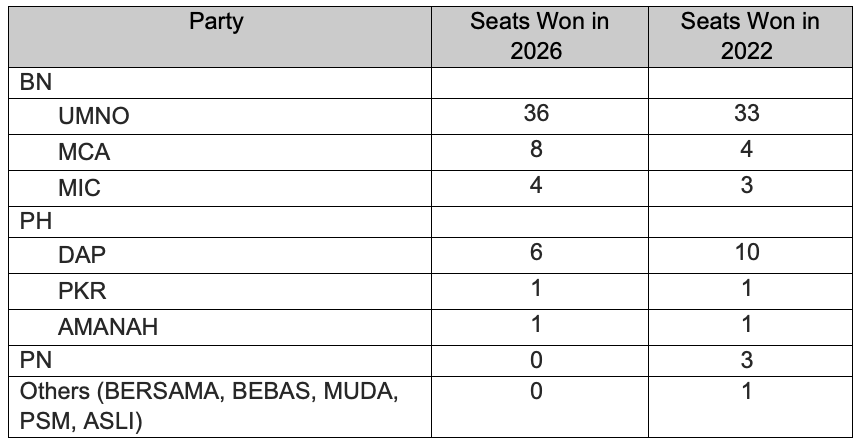
The 2026 Johor state election had a voter turnout of 69.57%, substantial increase from the 54.92% turnout recorded in the 2022 Johor state election.
Strong Mandate Reinforces Policy Continuity and Investment Confidence
The most immediate implication of the election is policy continuity in Johor, with the election reducing political uncertainty and reinforcing expectations that existing economic policies and development plans will remain firmly on track. With a commanding 48-seat majority, BN now possesses one of the strongest legislative mandates in the state's history. This gives the Johor administration significant room to implement its economic and development agenda without substantial political resistance. The result is expected to provide greater policy continuity for major investment initiatives, including the Johor-Singapore Special Economic Zone (JS-SEZ), infrastructure development, and manufacturing expansion. In 2025, Johor led all states with RM9.1 billion in approved investments over the first 9 months, with nearly three-quarters of the total tied to JS-SEZ projects.
Result Reshapes Political Dynamics Ahead of GE16
The Johor result raises the stakes for GE16 by increasing pressure on PH to demonstrate stronger policy delivery, while giving BN renewed momentum and political leverage. BN's landslide victory strengthens UMNO's confidence and bargaining position within the federal Unity Government, demonstrating that the coalition remains electorally competitive and capable of expanding support across both rural and urban constituencies. For PH, however, the outcome serves as a warning that support for the federal government cannot be taken for granted. The coalition's loss of several previously held seats has fueled concerns that persistent cost-of-living pressures and perceptions of slow reform could weigh on support ahead of GE16.


