
Council Policies
FCPA (ANTI-CORRUPTION)
The Council, its employees, and applicable stakeholders are subject to a variety of laws that govern interactions with foreign officials, most notably the U.S. Foreign Corrupt Practices Act (FCPA). The FCPA prohibits direct or indirect bribe payments to non-U.S. government officials. The Council’s Anti-Corruption Policy has been drafted to enable its employees, representatives, and applicable stakeholders to comply with these anti-corruption laws. The Anti-Corruption Policy applies to every officer, director, employee, and applicable stakeholder of the Council worldwide and addresses several areas that could present corruption risk for the Council, including: travel, lodging, meals, entertainment, gifts and charitable donations to non-U.S. government officials or entities, as well as hiring independent contractors and outside agents and partners.
All Council employees, representatives, and applicable stakeholders are required to receive mandatory annual training and must acknowledge receipt in writing of the Council’s Anti-Corruption Policy and to become thoroughly aware of its guidance and provisions. Further, to ensure that Council’s internal policies and procedures remain abreast with current legal and regulatory requirements of the place where it operates and consistent with the Council’s continuing commitment to strengthen its adherence with the FCPA, with the end in mind of continuously protecting the interest of its members and stakeholders, all Council employees, representatives, and applicable stakeholders are required to strictly observe the following list of relevant anti-bribery and anti-corruption laws applicable to each country where the Council operates.
Indonesia: Law No. 31 of 1999 on the Eradication of Criminal Act of Corruption; Law No. 11 of 1980 on the Criminal Act of Bribery; Supreme Court Regulation No. 13 of 2016 on Procedures for Handling Corporate Crimes; Existing and applicable provisions under Law No. 28 of 1999 on State Governance Free from Corruption, Collusion, and Nepotism (KKN), as other provisions were partially revoked by Law No. 30 of 2002 on Corruption Eradication Commission; The Indonesian Criminal Code (KUHP), as enacted through Law No. 1 of 1946 on Criminal Law.
Malaysia: Act 2009 (Malaysia Anti-Corruption Commission Act “MACC”); Act 574 (The Penal Code); Act 613 (Anti-Money Laundering, Anti-Terrorism Financing and Proceeds of Unlawful Activities Act 2001); Act 5 (Election Offences Act 1954); Act 777 (Companies Act 2016); Act 711 (Whistleblower Protection Act 2010).
Philippines: Act No. 3815 (The Revised Penal Code); Republic Act No. 3019 (Anti-Graft and Corrupt Practices Act); Republic Act No. 6713 (Code of Conduct and Ethical Standards for Public Officials and Employees); Presidential Decree No. 46 (No Gift Policy); Republic Act No. 9485, as amended by Republic Act No. 11032 (Ease of Doing Business Act); Republic Act No. 7080 (Anti-Plunder Act); Republic Act No. 9160, as amended by Republic Act No. 11521 (Anti-Money Laundering Act); Republic Act No. 12009 (New Government Procurement Act); Article XI of the Philippine Constitution.
Singapore: Prevention of Corruption Act 1960.
Thailand: Act Promulgating Criminal Code, B.E. 2499 (1956), including all applicable amendments; Organic Act on Anti-Corruption, B.E. 2561 (2018); Act on Offences Relating to the Submission of Bids to State Agencies, B.E. 2542 (1999); Anti-Money Laundering Act, B.E. 2542 (1999), including all amendments; Act on Offences Committed by Officials of State Organizations or Agencies, B.E. 2502 (1959); Criminal Procedure Code, B.E. 2477 (1934); Extradition Act, B.E. 2551 (2008); Act on Mutual Assistance in Criminal Matters, B.E. 2535 (1992).
Vietnam: Criminal Code No. 100/2015/QH13, as amended and supplemented by Law No. 12/2017/QH14 and Law No. 86/2025/QH15, Supreme People’s Court Resolution No. 03/2025/NQ-HÐTP (Guidelines for the Application of Regulations on the Communication of Death Penalty to Life Imprisonment), Resolution No. 03/2020/NQ-HÐTP (Guidelines for the Application of Criminal Code Provisions in Trial of Corruption Crimes and Other Position-Related Crimes), Resolution NO. 03/2019/NQ-HÐTP (Guidelines for the Application of Article 324 of the Criminal Code on the Crime of Money Laundering), Resolution No. 01/2016/NQ-HÐTP (Guidelines for the Application for Clause 3, Article 7 of the Criminal Code); Law on Anti-Money Laundering “AML” No. 14/2022/QH15, including Decree No. 19/2023/ND-CP (Detailing Law on AML), Decree No. 340/2025/ND-CP (Administrative Penalties in the Monetary and Banking Sectors), Circular No. 27/2025/TT-NHNN (Guidelines for the Implementation of Several Articles of Law on AML), Circular No. 09/2023/TT-NHNN (Guidelines for the Implementation of the Law on AML), Decision No. 11/2023/QD-TTg (Prescribing the Value of Large-Value Transactions Subject to Reporting); Law on Anti-Corruption 2018 No. 36/2018/QH14, as amended and supplemented by Law No. 132/2025/QH15; Decree No. 59/2019/ND-CP (Enforcement of the Law on Anti-Corruption 2018), as amended and supplemented by Decree No. 134/2021/ND-CP and Decree No. 184/2026/ND-CP; Decree No. 164/2026/ND-CP (Control of Assets and Income of Persons Holding Positions and Powers in Agencies, Organizations, and Units); Regulation No. 231-QD/TW of 2025 (Protection of Persons Fighting Against Corruption, Wastefulness, and Negativity); Law on Cadres and Civil Servants 2025 No. 80/2025/QH15, including Decree No. 17/2025/ND-CP (Recruitment, Employment, and Management of Civil Servants), Decree No. 172/2025/ND-CP (Disciplinary Actions Against Cadres and Civil Servants)
Any questions regarding application of the FCPA and other anti-corruption laws in the conduct of Council business should be addressed to the Council’s President and CEO or Compliance Officer/CFO.
Antitrust Compliance Statement
The US-ASEAN Business Council is committed to strict compliance with all applicable antitrust and competition laws. As a trade association, we bring together competitors and related stakeholders to advance common industry interests. It is therefore essential that all activities of the US-ASEAN Business Council, including meetings, communications, publications, and collaborations, are conducted in full compliance with these laws.
It is the policy of the US-ASEAN Business Council to:
- Comply fully with the letter and spirit of U.S. federal and state antitrust laws, as well as applicable international competition laws.
- Avoid any discussions, activities, or exchanges of information that could be construed as an agreement or understanding among competitors to restrain trade, fix or control prices, allocate markets or customers, restrict output, or otherwise limit competition.
- Ensure that all association meetings—including board, committee, member, and informal gatherings—are conducted for legitimate purposes and follow an agenda reviewed for antitrust compliance.
- Require all participants to refrain from any conduct that could violate or appear to violate antitrust or competition laws.
During any US-ASEAN Business Council activity, participants must not discuss or exchange information relating to:
- Prices, fees, discounts, or terms and conditions of sale or service;
- Costs, profit margins, or individual company financial data;
- Market shares, sales territories, customers, or suppliers;
- Plans for future pricing, marketing, or product strategies;
- Boycotts, refusals to deal, or restrictions on competition;
- Any other competitively sensitive information.
- All official meetings shall have a written agenda and recorded minutes.
- A staff member or legal counsel shall review agendas and materials for antitrust sensitivity.
- If any improper discussion arises, participants must promptly object and the discussion must cease immediately.
Each member, director, officer, committee chair, and staff member has a personal responsibility to comply with this policy. Violations of antitrust law can result in severe civil and criminal penalties for both individuals and organizations.
Participation in US-ASEAN Business Council activities signifies understanding and agreement to comply with this Antitrust Compliance Statement.
Data Privacy Policy
Law: The US-ASEAN Business Council is licensed to operate in Washington, DC. The District of Columbia does not have a general privacy law in effect. Interested parties may visit US State Law Tracker to monitor the progress of US State bills.
Regulator: The Office of the Attorney General for the District of Columbia ('AG')
Summary: Although the District of Columbia ('DC') does not currently have a general privacy act, the State has references to privacy through the Constitution for the State of New Columbia and the common law tort for the invasion of privacy, which has been long recognized by DC courts.
As Washington, DC is not a state, the process through which bills become laws is unique. The Mayor of the Government of the District of Columbia can either sign the legislation, allow it to become effective without signature or disapprove the legislation. If the latter is the result, the bill will undergo Congressional Review by the U.S. House of Representatives and the U.S. Senate before becoming an official law, as was the case with DC breach law. DC's breach notification law, through the Security Breach Protection Amendment Act of 2019 ('the Act'), entered into effect on 10 April 2020 following its publication in the DC Register, and is due to be projected as an official law on 8 June 2020. Specifically, the Act amends the current breach notification law by, among other things, protecting a broader range of personal information and establishing various security requirements for companies handling personal information.
Timeline
On October 18, 2021, the DC City Council introduced DC B24-045, a bill based on the Uniform Personal Data Protection Act (UPDPA). The bill aims to apply fair information practices to how businesses collect and use consumer data. UPDPA is a law created by the non-partisan Uniform Law Commission (ULC) to guide states in enacting broad privacy laws. Lawmakers consider it to be a model bill and if adopted would apply to businesses including nonprofits such as the Council, operating in the District of Columbia. As of September 2024, the UPDPA has yet to be adopted.
Record Retention Policy
The US-ASEAN Business Council (USABC) and the US-ASEAN Business Council Institute (USABCI) follow the guidelines that govern nonprofits as prescribed by Sarbanes-Oxley. USABC utilizes sustainable records retention practices considering the period of their immediate or current use unless longer retention is necessary for historical reference or to comply with contractual, state, federal of District of Columbia legal requirements. Records and documents outlined in this policy include paper, electronic files (including e-mail), cloud, and voicemail records regardless of where the document is stored, including network servers, desktop or laptop computers and handheld computers and other wireless devices with text messaging capabilities. If any two or more retention periods below conflict, the records and documents must be retained for the greatest retention period among those conflicting. For records or documents where the applicable retention period has expired, such records or documents must be disposed of and destroyed in a secure and confidential manner.
Record Retention and Document Destruction Policy
The US-ASEAN Business Council (USABC) and the US-ASEAN Business Council Institute (USABCI) records retention policies consider sustainability, economics, and legal requirements for the period of their immediate or current use unless longer retention is necessary for historical reference or for compliance purposes. Records and documents outlined in this policy include paper, cloud, electronic files (including e-mail), and voicemail records regardless of where the document is stored, including network servers, desktop or laptop computers and handheld computers and other wireless devices with text messaging capabilities. If any two or more retention periods below conflict, the records and documents must be retained for the greatest retention period among those conflicting. For records or documents where the applicable retention period has expired, such records or documents must be disposed of and destroyed in a secure and confidential manner.
In accordance with 18 U.S.C. Section 1519 and the Sarbanes Oxley Act, USABC shall not knowingly destroy a document with the intent to obstruct or influence an “investigation or proper administration of any matter within the jurisdiction of any department agency of the United States . . . or in relation to or contemplation of such matter or case." If an official investigation is underway or even suspected, document purging must stop to avoid criminal obstruction. In addition, from time to time, USABC’s general counsel may direct the staff and/or Board of Directors to cease any document destruction (or destruction for certain categories of documents), in which case such document destruction shall cease until the general counsel lifts the restriction.
All employees, directors, officers, personnel, and other agents and representatives of USABC are subject to, and expected to comply with the terms of, this Policy. Any violation or breach of this Policy may result in disciplinary action, including possible termination of employment with USABC or criminal prosecution for federal obstruction of justice. Any known or suspected violation of this policy may be reported by following the procedures established by the USABC Whistleblower Protection Policy. USABC will not allow any retaliation against an employee, director, officer, agent, or representative who acts in good faith in reporting any such violation or suspected violation. All questions regarding the retention or destruction of specific documents or records should be directed to USABC’s general counsel.
To eliminate accidental or innocent destruction, USABC has the following document retention policy:
Record Retention for Nonprofits
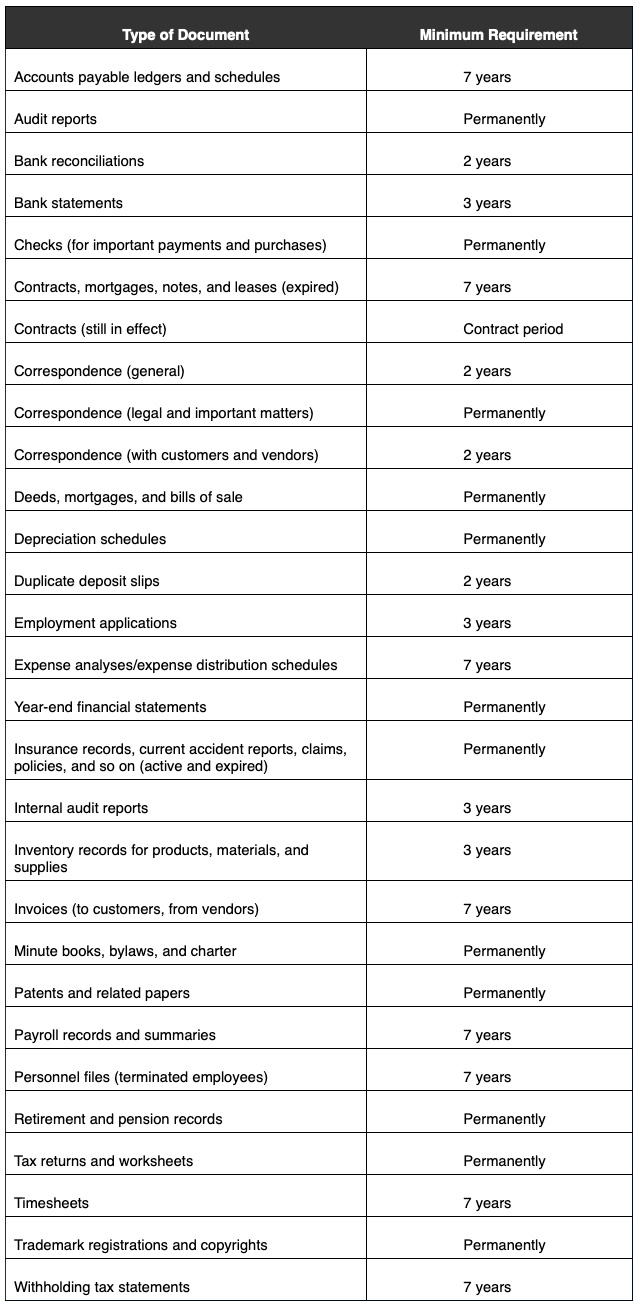
The following table* indicates the minimum requirements for nonprofits operating in the District of Colombia in 2024. Because statutes of limitations and state and government agency requirements vary from state to state, and because USABC has offices in West VA, and overseas, its requirements may vary with each jurisdiction. In addition, USABCI has received federal awards and other government grants and Memorandum of Agreements and Understanding, and those requirements may provide for a longer period than is required by other statutory requirements.
Resources
- National Council of Nonprofits www.councilofnonprofits.org
- BoardSource Record Retention and Document Destruction Policy—Download 4 Samples (E-Policy Sampler) www.boardsource.org/Bookstore.asp?Type=epolicy&Item=1071
- Independent Sector www.independentsector.org/issues/sarbanesoxley.html
- AICPA Management of an Accounting Handbook—2003 and IRS Appendix Document www.cpa2biz.com/AST/Main/CPA2BIZ_Primary/PracticeManagement/PracticeAdministration/PRDOVR~PC-090407/PC-090407.jsp
- Guide to Record Retention Requirements in the Code of Federal Regulations: Contact the Superintendent of Documents, U.S. Government Printing Office, Washington, D.C. 20402-9325 or from CCH, Inc. at www.onlinestore.cch.com
Commitment To Diversity, Anti-Discrimination, and Anti-Harassment Policy
The US-ASEAN Business Council is committed to creating and maintaining a workplace in which all employees have an opportunity to participate and contribute to the success of the business and are valued for their skills, experience, and unique perspectives. This commitment is embodied in company policy and the way we do business at the Council and is an important principle of sound business management.
In addition, the Council will not tolerate harassment, verbal abuse, or mistreatment of staff by a member or an outsider under any circumstances.
It is the Council’s policy to treat all employees with respect and dignity. The Council maintains a strict policy of “zero-tolerance” with respect to unlawful employee discrimination and harassment, including discrimination or harassment based on race, color, religion, national origin, sex, age, marital status, personal appearance, sexual orientation, gender identity or expression, familial status, family responsibilities, disability, education, source of income, place of business or residence, political affiliation, military status, genetic information, or any other protected category covered by applicable law.
Harassment on the basis of race, color, religion, national origin, sex, age, marital status, personal appearance, sexual orientation, gender identity or expression, familial status, family responsibilities, disability, education, source of income, place of business or residence, political affiliation, military status, genetic information, or any other protected category covered by applicable law is defined as unwelcome verbal or physical conduct relating to such basis, when:
- Submission to such conduct is made either an explicit or implicit condition of employment or is used as the basis for an employment decision affecting the harassed employee; or
- The harassment unreasonably interferes with an employee’s work performance or creates an intimidating, hostile or offensive working environment.
All such harassment is strictly prohibited under this policy. Prohibited harassment includes sexual harassment or any unwelcome behavior that is sexual in nature. Harassment in employment can occur, and is prohibited, both in the workplace and off the premises, including social activities sponsored by the Council.
Specific examples of prohibited harassment may include, but are not limited to, the following when related to any of the protected characteristics stated in this policy: verbal abuse or ridicule, including slurs, epithets, and stereotyping; offensive jokes and comments; threatening, intimidating or hostile acts; and displaying or distributing offensive materials, writing, graffiti, or pictures.
Become a part of the council
View membership plansJoin today! The US-ASEAN Business Council represents more than 150 major U.S. companies with a presence or interest in Southeast Asia.