Timor-Leste's ASEAN Destiny

This October 2025, the ten member states of ASEAN will become eleven with the full accession of the Democratic Republic of Timor-Leste, commonly known as East Timor. Since the small but resilient democracy’s designation as an ASEAN Observer State in 2022, Timor-Leste has been dedicatedly working toward full membership. According to Malaysian Prime Minister Anwar Ibrahim, whose country chairs ASEAN for 2025, “The decision is [that] they will be accepted as [a] full member at the October ASEAN Summit.”
Malaysia has centered its 2025 ASEAN Chairmanship around the themes of “Inclusivity and Sustainability,” the former of which is certainly in-line with the Anwar Administration's support of Timor-Leste's ASEAN membership. In 2023, the ASEAN Secretariat itself even issued a formal roadmap for Timor-Leste's accession process, all requirements of which have been filled minus “one or two” more conditions under ASEAN’s economic pillar, once again according to Malaysian Prime Minister Anwar Ibrahim.
Timor-Leste was officially recognized by the UN as an independent state in 2002 following their secession from Indonesia. Rich in natural resources and with a young population of nearly 1.4 million, Timor-Leste is also Asia’s newest country. A former Portuguese colony up until 1975, the country holds the co-official languages of Portuguese and Tetum, an Austronesian language endemic to the broader island of Timor.
Another remnant of their colonial legacy is the fact that Timor-Leste is the 2nd most Catholic country per-capita in the world, behind only Vatican City. 97.6% of the population identifies as Catholic. Also of note, Timor-Leste' official currency is the United States Dollar for its stability and global acceptance, again speaking to the mixed influences in the country. Hybrid-approaches, creative efforts, and desire for a national identity and global standing speak to the national motto of Timor-Leste, "Unidade, Acção, Progresso," which translates to "Unity, Action, Progress" in English.
Timor-Leste is certainly an outlier from its regional peers in many respects, and the country has been in geopolitical “limbo” throughout their waiting period since applying for ASEAN membership in 2011. Yet national resilience, patience, ingenuity, and the charisma of leaders such as current President José Ramos-Horta, the country’s most prominent “founding father,” have seen to the fruition of their ASEAN identity. Regardless of Timor-Leste's long and winding path, all differences aside, ASEAN is already one of the most diverse regions in the world, across metrics such as regime type, language, religion, human development, and more. As such, Timor-Leste's pending membership and what they bring to the table are only fitting.
Diversity can be seen as one of ASEAN’s greatest strengths, fostering the benefits of having multiple perspectives, different specializations and skills, and the ability to bolster each other in the face of geopolitical headwinds. Yet with ASEAN operating as an institution based on consensus, the addition of Timor-Leste to the mix will bring along new internal deliberations.
"The ASEAN Way" of Consensus
Timor-Leste has a lot to gain by adhering to ASEAN’s founding principles. This includes signing on to not only the ASEAN Charter and its core tenets, but also the ASEAN Comprehensive Investment Agreement (ACIA), the ASEAN Free Trade Area (AFTA), and the ASEAN Mutual Recognition Arrangements (MRAs). These frameworks will allow the country’s relatively small, developing economy and burgeoning political institutions to also benefit from the multilateral agreements established by its neighbors and soon-to-be fellow members.
ASEAN also operates within a bloc-wide consensus-building process, as in all member states must agree to a decision or joint statement before it is made. While this promotes unity, it has also extremely hindered the bloc’s ability to navigate contentious, polarizing issues such as maritime domain awareness in the South China Sea and the Myanmar Civil War. The latter of these issues is the exact reason that one ASEAN member, Myanmar, objects to Timor-Leste's accession. According to Myanmar junta official Han Win Aung, “Timor-Leste does not adhere to the principle of non-interference in internal affairs, as enshrined in the ASEAN Charter.” This is in reference to how both Timor-Leste’s Prime Minister, Xanana Gusmao, and President, José Ramos-Horta, have publicly criticized Myanmar’s ruling military junta and directly supported the exiled National Unity Government (NUG).
Nonetheless, the ASEAN Secretariat, Malaysia as 2025 ASEAN Chair, and most recently, the foreign ministers of all member states present for the ASEAN Foreign Ministers’ Meeting on July 9, continue to support Timor-Leste's accession and have yet to formally respond to Myanmar's objections. This is besides the fact that Myanmar is currently under ASEAN sanctions and has been excluded from high-level meetings since the 2021 military coup, currently holding limited influence within the bloc. This situation is consistent with both Timor-Leste's vocalness on democracy and human rights issues as well as Myanmar’s uncooperative relationship with ASEAN. Both put into question the practicality of ASEAN’s need for consensus in its policies, and adding Timor-Leste into the mix will certainly add more variables for the bloc to consider.
There is a widening economic disparity among ASEAN member states, and at only $1,000 USD, Timor-Leste's annual GDP per capita will rank the lowest. With the formal economy being as nascent as it is, Timor-Leste will rely heavily on foreign partners to develop initial systems and infrastructure, creating an “uneven distribution of aid” which could eventually irritate other members and undermine cohesion within ASEAN as well. As such, in order to demonstrate their initiative and “pull their weight,” it will be critical for Timor-Leste to maximize and capitalize on what resources they have and work with partners that will empower them to develop sustainably and equitably.
Trade Diversification and Critical Industries
Not unlike other less developed ASEAN members, Timor-Leste has a history of receiving developmental assistance from China, most prominently in infrastructure development and construction of utilities. These areas, in addition to education, food security, and healthcare, are the baseline sectors whose promotion will help raise human development standards in the country. Inclusion in ASEAN trade agreements such as the ASEAN Economic Community (AEC), Regional Comprehensive Economic Partnership (RCEP), and the ASEAN+1 Free Trade Agreements (FTA), will also give Timor-Leste enhanced access to more diversified economic partnerships regionally and beyond. While developmental assistance and government-to-government relationships will play a role in national growth (Timor-Leste happens to have a very strong diplomatic corps), FDI and the U.S. private sector may contribute just as much so through groundbreaking opportunities in select industries.
Timor-Leste's greatest material asset by far is its majority share (56.56%) of the Greater Sunrise gas field off its southern coast, jointly administered by Australia's Woodside Energy (33.44%) and Japan’s Osaka Gas (10%). Timor-Leste's national oil company, Timor GAP, has only scratched the surface of the reserves’ potential, even with stockpiled proceeds in its Petroleum Fund already exceeding $18 billion USD (roughly 10 times national GDP). If jointly developed through the 2024 agreement between all stakeholders, the project is valued at approximately $50-75 billion USD. As such, Timor GAP and the Government have expressed a great desire for reliable, U.S.-based partners with relevant expertise to invest in a multi-stage project: completion of a feasibility study on Greater Sunrise gas field, construction of a pipeline connecting reserves to Timor-Leste, and establishment of the first LNG refinery on East-Timorese soil.
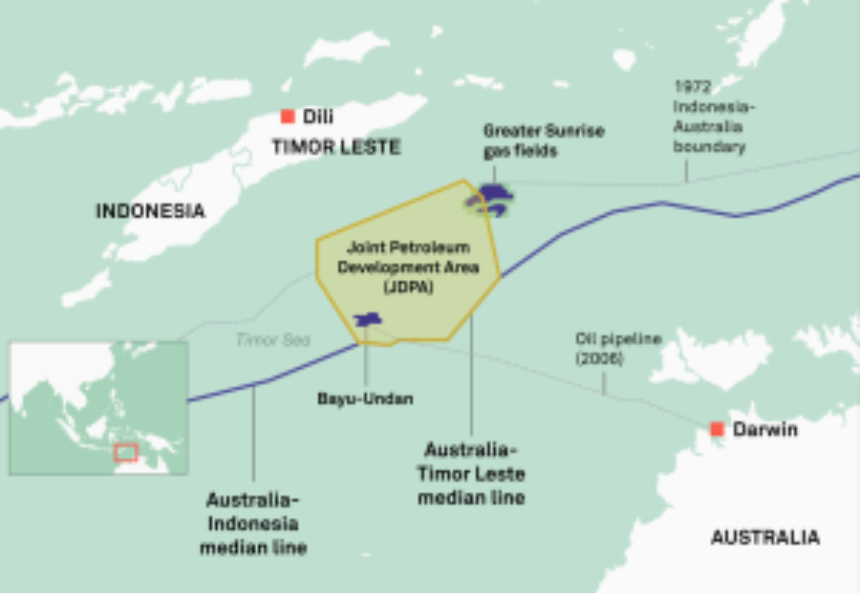
While such a revenue-generating project would certainly boost Timor-Leste's economic standing and capacity to provide for its populace, it is critical that the formation of a rentier state is avoided. Creating an economy based solely on extraction and sale of a limited resource can kickstart growth but is by no means sustainable. Along with the development of a more robust oil & gas sector in the country should come the promotion of other “early mover” industries such as eco-tourism and hospitality, showcasing Timor-Leste's natural beauty and “green” spaces; financial services, promoting a more formal economy and payment network; and ICT, creating digital infrastructure and capabilities from the ground up.
Unidade, Acção, Progresso - Unity, Action, Progress
Political capital, relationship-building, and economic diversification are what Timor-Leste needs now more than anything during this critical juncture. The U.S. private sector has been a partner in this regard for several other ASEAN states, and the bloc’s newest member should be no exception. With the 47th ASEAN Summit in October fast approaching, companies should see how they can help lay the groundwork for business in a market full of opportunity that is incredibly eager and enthusiastic to engage. Timor-Leste's ASEAN accession will serve as a test not just for ASEAN’s cohesion and regional influences but also the willingness of the international business community to uplift emerging economies.