Upgrade your membership plan for the full website experience.
View Membership Plans
March 3, 2026

Southeast Asian Countries Advances International AI Collaboration and Adoption


India Ai impact summit 2026
Official photo of heads of state, heads of government, and ministers at the AI Impact India Summit 2026, New Delhi. Credit: Ricardo Stuckert / PR — https://cop30.br/en/news-about-cop30/following-cop30-and-the-ai-impact-summit-brazil-and-india-launch-the-open-planetary-intelligence-network-opin
March 3, 2026

As of February 21, the AI Impact Summit Declaration has been signed by 91 countries and international organizations, including Cambodia, Indonesia, Myanmar, the Philippines, and Singapore. The Declaration highlighted a growing focus on inclusive AI adoption, calling for the democratization of AI resources, wide-scale adoption of trusted AI to advance socio-economic goals, and advancement of AI innovation and international cooperation. In addition to the core Declaration, the Summit also led to the adoption of voluntary global initiatives to support greater collaboration. Indonesia, the Philippines, and Singapore played active roles in co-chairing working groups for economic growth and social goodhuman capital, and science, underscoring ASEAN Member States’ growing engagement in international AI discussions. 
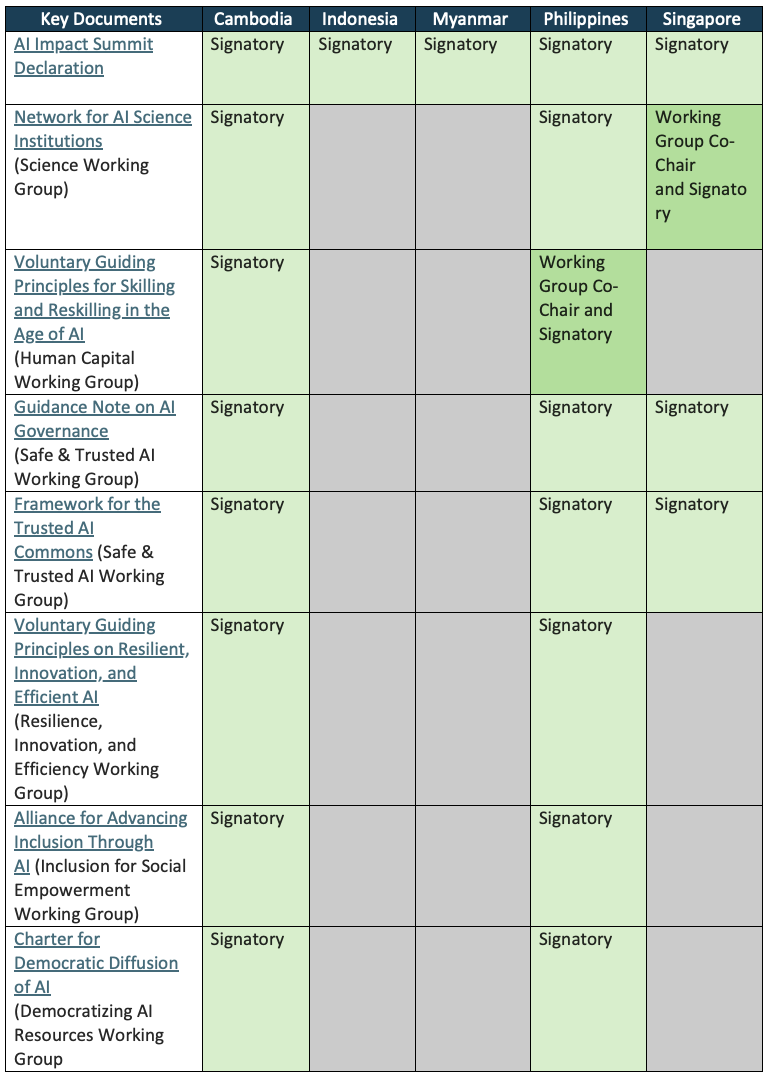
Table: Endorsement of AI Impact Summit Documents by ASEAN Member States

Meanwhile, the pace of AI adoption in Southeast Asia remains ahead of the global average, with nearly half of surveyed Southeast Asia companies beyond AI pilot stage, particularly for IT, software engineering, knowledge management, and HR functions. Underpinning this momentum are several structural advantages, including over US$50 billion in hyperscaler infrastructure investment, new subsea cable deployments, availability of regional AI solution providers, and a large, young consumer base. However, talent shortages, institutional readiness, uncertainty on the financial returns of AI integration, and complex implementation continue to constrain businesses' ability to fully capitalize on AI-driven growth. Scaling challenges are expected to continue with the growing adoption of agentic AI due to a lack of specialized expertise, highlighting the importance of continued public-private partnerships and capacity-building, particularly for SMEs. Most recently, Vietnam’s AI Law has taken effect, making it the first Southeast Asian country to implement regulatory measures to address AI-related concerns and opportunities. 

Join the Council to continue reading this article
Enhance your business impact in Southeast Asia: Become a member of the US-ASEAN Business Council and tap into a network of possibilities.
Free Related Articles

Membership Plans

Corporate Council

Corporate membership provides general advocacy support, access to all country- and industry-specific updates, and access to most Council events.

  • Business missions to all 10 ASEAN markets which engage governments at the highest levels.
  • Off-the-record roundtables and policy briefings with senior government leaders in ASEAN and the U.S.
  • On-the-ground support for promoting your positions/policy priorities with policy makers.
  • Industry-specific, country-specific, cross-sector and regional advocacy through committees that target their engagement based on member priorities.
  • Advocacy on your behalf in situations where your company should not be directly identified or is unable to be present.

Chairman’s Council

Corporate membership provides general advocacy support, access to all country- and industry-specific updates, and access to most Council events.

  • All Corporate benefits.
  • Assistance with resolving company-specific trade or investment issues through our six regional offices and U.S.-based staff.
  • Develop effective advocacy strategies to impact policy concerns.
  • Identification of, and engagement with appropriate policy influencers to impact policy concerns.
  • Assistance in conducting follow-up after engaging government leaders (can include providing officials with additional materials, setting up meetings with their staff, getting a readout of the government’s reaction to the discussion).
  • Support for developing arguments that will resonate with target stakeholders.
  • Leading and setting the agenda and policy priorities of the Country and Industry Committees.