



Regional Responses to the Middle East Energy Crisis
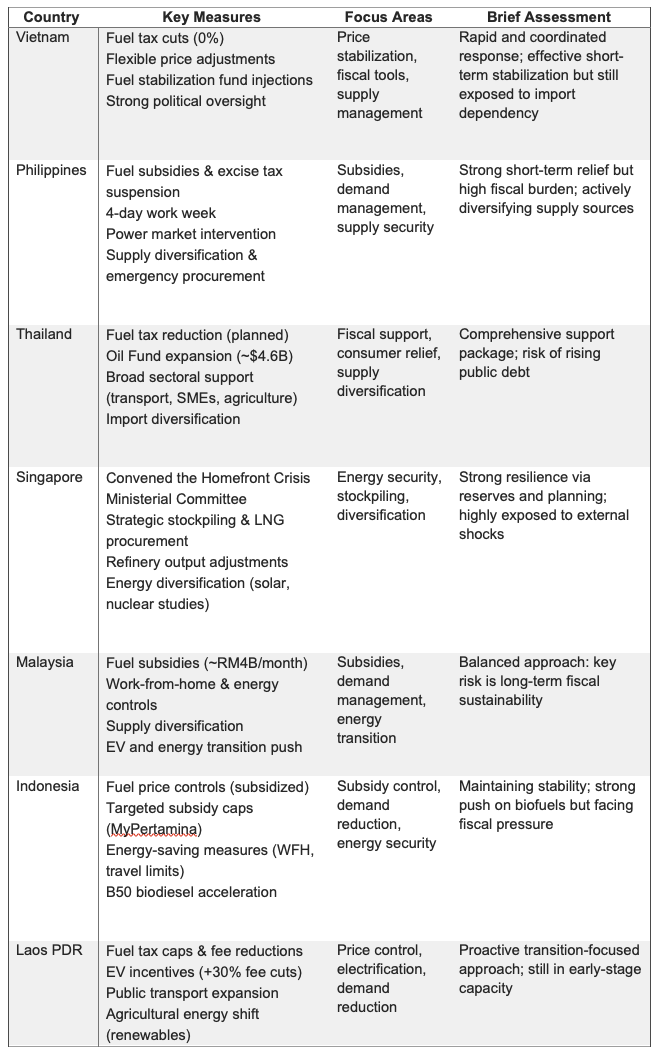
Across ASEAN, government responses to the energy crisis reflect a layered approach that balances immediate stabilization with longer-term structural adjustment. In the short term, most countries have relied heavily on subsidies, tax cuts, and price controls to contain inflation and protect households and businesses. Examples include measures such as the Government of Vietnam’s temporary tax reductions to 0% and the Malaysia government’s domestic fuel subsidies reaching RM4 billion per month (~USD 1 billion). At the same time, governments are introducing demand-side management policies, including work-from-home arrangements in Indonesia and Malaysia, and a four-day work week in the Philippines, to reduce fuel consumption and ease pressure on energy systems. In the medium term, there is a clear shift toward supply diversification and emergency procurement, as countries seek to reduce reliance on Middle Eastern energy sources and build greater resilience against global disruptions. Longer term, for high growth region like ASEAN it remains to be seen if the magnitude of this external shock and subsequent energy crises incentivizes shifts in the relative balances between deepening energy security and driving energy transitions.
The following section provides highlights of how individual ASEAN countries are responding to the crisis, along with key implications for businesses in anticipating policy shifts, operational adjustments, and emerging opportunities across the region.
Vietnam
Vietnam implemented rapid measures combining regulatory flexibility and fiscal intervention. Under Resolution 36/NQ-CP (March 6) and Resolution 55/NQ-CP (March 19), authorities could adjust fuel prices immediately. Decree 72/2026/NĐ-CP (March 9) reduced import tariffs to 0%, while PM Decisions 482 & 483 (March 26–27) removed fuel taxes and injected VND 8 trillion (~US$303.7M) into the stabilization fund (with ~US$217M disbursed). These actions helped reduce peak price spikes (diesel +111%, gasoline +77%). Vietnam has not introduced formal work-from-home (WFH) mandates, instead relying on price controls and supply-side interventions.
USABC members can expect growing opportunities in energy supply and infrastructure development, through these will be accompanied by increased policy intervention and demand-side controls. Measures such as flexible work arrangements may also affect business operations and energy consumption patterns.
Philippines
The Philippines focused on subsidies, tax relief, and demand management. The government authorized fuel excise tax suspension (March 25) and introduced conservation measures, including a four-day work week for public agencies and 10–20% mandatory energy reductions. As ASEAN Chair, the Philippines is hosting a number of ministerial gatherings this year, and has announced that nearly all of those will be virtual, starting with the April 8-10 Meeting of Finance Ministers and Central Bank Governors. The Wholesale Electricity Spot Market was suspended (March 26) to stabilize power prices. Supply diversification includes new sourcing agreements and 700,000 barrels of Russian crude, supported by a national crisis committee.
There are expanding opportunities in energy financing and diversification across the region. However, members should remain attentive to fiscal risks, as well as the potential introduction of demand-side policies that could shape future energy consumption and investment dynamics.
Thailand
Thailand introduced a broad fiscal support package, including a proposed 150 billion baht (~US$4.6B) Oil Fund guarantee and targeted relief (e.g., 100 baht/month support for 13.5 million people, 10 billion baht SME loans). Additional support includes discounted B20 fuel (5–6 baht below diesel) and sectoral assistance. Thailand has not implemented nationwide work-from-home (WFH) mandates, focusing instead on subsidies and financial relief. However, demand-side measures may evolve if prices remain elevated.
ASEAN’s continued role as a regional energy and trading hub presents strong opportunities in LNG, infrastructure, and advanced energy solutions. At the same time, members should be mindful of exposure to global market volatility, which may influence investment conditions and trade flows.
Singapore
Singapore activated the Homefront Crisis Ministerial Committee (April 2) to coordinate its national response. With ~55% dependence on Middle East crude, the country is strengthening its existing energy stockpiles through its LNG procurement mechanism (via Singapore GasCo), and building a second LNG terminal. Singapore has not implemented WFH mandates, but has instead emphasized the importance of system resilience and supply security. Businesses may adopt flexible arrangements voluntarily as part of cost management.
The implementation of WFH policies may reshape workforce operations and productivity models. Meanwhile, rising energy subsidies could signal future policy reforms. Despite this, opportunities remain robust in energy efficiency and transition technologies.
Malaysia
Malaysia is managing the crisis through fuel subsidies (~RM4 billion/month), price controls, and supply coordination with Petronas. A key demand-side measure is the WFH policy announced April 1, effective April 15, covering government agencies, GLCs, and public institutions to reduce fuel consumption. Energy controls in public buildings and fiscal tightening signals complement ongoing EV and clean energy initiatives.
While the consumer environment remains relatively stable, increasing fiscal pressures may drive future policy adjustments. WFH measures and mobility restrictions could impact operations and logistics, but significant opportunities persist in biofuels and broader energy transition initiatives.
Indonesia
Indonesia is maintaining fuel price stability despite oil exceeding US$100/barrel (vs. US$70 budget assumption). Measures include a 50-liter/day fuel cap (MyPertamina, April 1) and spending cuts saving Rp40 trillion (~US$2.3B). Demand-side measures include mandatory WFH for civil servants every Friday, encouragement for private sector adoption, and restrictions on official vehicle use (cut by 50%). The government is also accelerating the B50 biodiesel mandate (July 1, 2026) to reduce fossil fuel dependence.
Although markets may be limited in scale in the short term, there are emerging opportunities in electric vehicles (EVs), infrastructure, and renewable energy—particularly in early-stage markets that are beginning to accelerate their energy transition efforts.
Laos PDR
Laos implemented fuel tax caps (21% diesel, 31% gasoline) and fee reductions until June 30, 2026. Demand-side measures focus on public transport expansion, including free bus services and BRT development, rather than WFH policies. There is no formal WFH policy, but the government is reducing fuel demand through mobility alternatives and promoting EV adoption (10% target in 2026, 30% fee reduction).
USABC members may face limited scale in the near term, particularly in less mature markets. However, these markets present emerging opportunities in electric vehicles (EVs), infrastructure development, and renewable energy. As early-stage ecosystems continue to evolve, companies that engage early may be well-positioned to capture long-term growth and shape market development.
ASEAN’s Alignment on Crisis Response with Long-Term Energy Transition
Looking ahead, ASEAN economies are increasingly aligning crisis response with long-term energy transition strategies, including biofuels (Indonesia’s B50 mandate), EV adoption (Malaysia and Laos), and LNG and nuclear exploration (Singapore, Philippines). However, progress remains uneven and constrained by continued dependence on fossil fuels and rising fiscal burdens.
For USABC members, this evolving landscape presents both challenges and opportunities. Companies should expect continued policy intervention, regulatory shifts, and operational adjustments—including workforce flexibility measures—while also positioning to capture growing demand for U.S. expertise in energy, infrastructure, digital systems, and financing solutions. The region’s transition toward more diversified and sustainable energy systems creates a strategic opening for U.S. businesses to play a leading role in shaping ASEAN’s next phase of growth and resilience.
Matrix Summary of ASEAN’s Response to Energy Crisis